
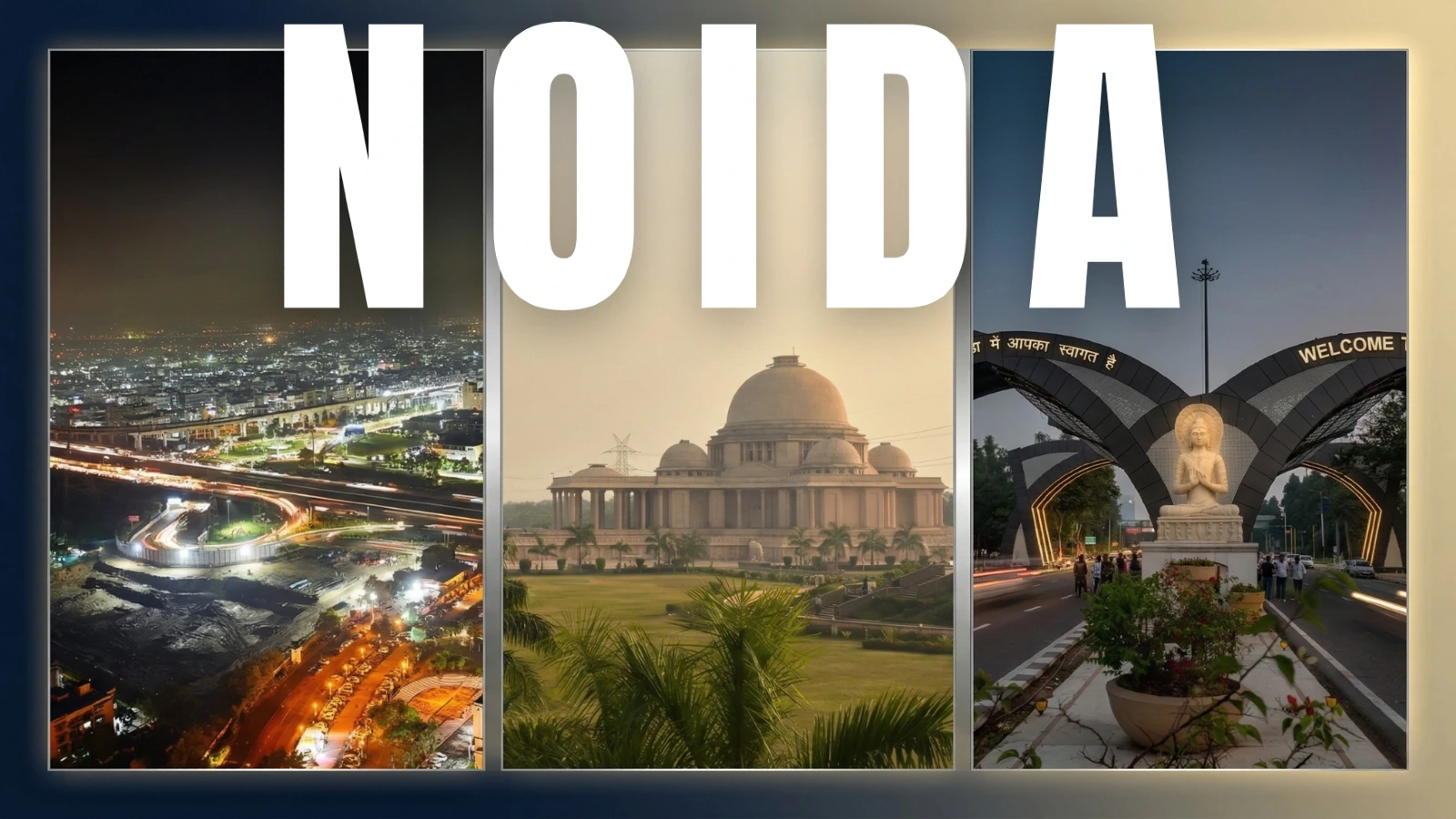
Anyone who has spent meaningful time in Noida understands that this city did not grow in one dramatic burst. It expanded in layers, and each layer still coexists with the others. That layered growth is the reason property here behaves differently from more impulsive markets. These layers also are not haphazard but rather structured bringing an overall order and discipline to the Noida city.
If you fly over this city, the sector grid is visible where roads align cleanly. Residential clusters sit within defined boundaries, markets and institutional pockets are not randomly stitched together. It becomes clear that this design discipline is not cosmetic but planned and this planning is what influences the overall Real estate market here. If you stand in Sector 27, then drive through Sector 75, then continue onto the expressway toward Sector 150, you will experience three generations of residential philosophy within fifteen kilometres.
The Chronological Evolution of Noida Residential Sectors
Below is a simplified structural timeline of how residential Noida expanded.
Lets start from the very beginning when Noida was just taking baby steps, towards urban development planning, but was still known as an industrial township.
Phase 1: Foundational Plotted Sectors (Late 1980s to Early 2000s)
The Original Residential Sectors | Primary Format | Infrastructure Status | Liquidity Profile | Buyer Type |
27, 19, 20, 12, 22, 26, 30, 37 | Independent houses, authority plots | Fully mature | Stable, niche-driven | Long-term end users |
Before high-rise towers, before large private developers, before the expressway corridor became aspirational, Noida’s residential identity was largely defined by plotted development.
Sectors such as 27, 19, 20, 12, 22, 26, 30 and 37 formed part of the earliest wave of residential planning. At the time, much of this land had recently transitioned from agricultural use or village boundaries into planned urban grids. The Noida Authority carved out blocks with straightforward road alignments and began allotting housing in a fairly institutional manner.
Sectors 27, 19, 12 and 22 were significantly allotted to employees of the Noida Authority in LIG, MIG and HIG configurations. Portions were used as staff quarters. Between these institutional allotments, independent plots were made available for private construction. Those plots quietly attracted business families, particularly industrialists and traders from East Delhi who already operated units in Noida’s developing industrial belts. Since the allotment policy gave preference to industry owners, settlement followed economic linkage, speculation was a foreign word at the time.
That detail matters because it explains why these sectors developed with a certain long-term stability. Residents were not early-stage investors hoping for appreciation. They were either employees posted here or families with business interests tied to the city’s growth.
Sector 27 became especially active from a commercial cum staff residence perspective. Indira Market developed here and gradually expanded behind inside the narrow lanes of Atta village. Over time, it evolved into what is now known as Atta Market yet maintaining its identity in the byelanes of the village. Many of the early shop owners from Atta Market later invested in commercial units in Sector 18 as that area began developing. That gradual migration formed the foundation of what would eventually become Noida’s most recognised retail hub.
Alongside civilian residential development, several sectors were earmarked for defence housing. The Air Force Naval Housing Board and the Army Welfare Housing Organization developed projects that residents informally began referring to as the “army sectors.” By current standards the buildings were modest, typically ground plus three floors, but at the time they represented organised group housing formats.
Sectors 21 and 25, known as Jalvayu Vihar, were developed by AFNHB across roughly 25 acres and comprised close to 2,000 units in two, three, four and five bedroom configurations. Basement parking had not yet become standard. Smaller units included scooter garages, while larger homes had car garages at ground level. Over the years, many of those garages evolved into small neighbourhood retail outlets. Grocery stores, stationery shops, video game parlours, VCR rental counters, comic lending libraries and even seasonal kite shops operated out of them. For many residents, those improvised commercial spaces formed part of everyday life and contributed to a localised ecosystem that felt organic rather than planned.
Sectors 28, 29 and 37, especially the Arun Vihar area developed by AWHO, covers close to 300 acres and includes around 4,752 residential units along with parks, internal roads, shopping centres and institutional facilities. Sector 37 became associated with the Arun Vihar Club, Lal Market and the first CSD canteen in Noida, all of which became part of the social structure rather than external attractions.
Sector 29 developed its own identity through what residents referred to as “Mall Road,” one of the earliest walkable commercial stretches in the city. Its proximity to Brahmaputra Market attracted students and young visitors, who frequented the area for affordable shopping and street food well before organised mall culture took hold in NCR.
Today, these foundational sectors remain infrastructure-complete neighbourhoods. Schools, clinics, markets and public spaces are already established. Liquidity exists, although the buyer pool is specific. Price movement tends to be gradual, influenced by land scarcity and location familiarity rather than dramatic sentiment swings. These areas rarely dominate headlines, but they quietly anchor the city’s baseline stability.
Phase 2: Early Apartment Communities (Early 2000s to 2010)
Sector | Housing Type | Key Strength | Resale Stability | Rental Demand |
50, 51, 61 | Gated apartment societies | Infrastructure + community living | Strong | Consistent |
As urban density increased and land prices gradually rose, Noida began transitioning toward civilian apartment living beyond defence housing.
Sectors 50, 51 and 61 represent this second phase. These were among the earliest large-scale gated apartment societies developed for the broader civilian market. They were not positioned as ultra-luxury projects, nor were they experimental. They were structured housing formats with defined security, internal parks, resident associations and maintenance systems.
Because these sectors developed adjacent to older plotted areas, they inherited functioning infrastructure. Residents did not need to wait for schools, clinics or markets to emerge. Daily life could begin immediately after possession, even if, initially the infrastructure was not there, it developed in the time while the buildings were getting constructed.
The scale of construction was moderate. Towers were not excessively tall, and internal spaces felt proportionate. Over time, these sectors attracted a mix of families upgrading from older independent houses and renters working in nearby commercial and industrial pockets.
Resale activity in these sectors has generally remained consistent because the demand profile is broad. They appeal to families seeking balance rather than spectacle. When buyers evaluate livability parameters in Best Areas to Live in Noida, sectors such as 50 and 61 often surface not because they are the newest, but because they offer familiarity combined with community housing.
If one spends an evening inside these societies today, the rhythm feels settled. The buildings are no longer new, yet they are not transitional either. Maintenance systems have evolved and RWAs have matured. These sectors became a bridge between the plotted origins of Noida and the larger builder-led expansion that followed.
Phase 3: Builder Group Housing Expansion (2010 to 2016)
Sector Range | Housing Format | Density Level | Price Volatility | Investment Risk |
71, 74, 75, 76, 78, 79 | High-rise group housing | Moderate to high | Cyclical | Project dependent |
The next stage altered the skyline more visibly and this can be termed as the expansion wave. Sectors 74, 75, 76, 71, 78 and 79 saw large-scale builder group housing projects come up within a relatively short time span. Towers grew taller, clubhouses became central selling points and marketing stories intensified.
This period coincided with heightened investor participation across NCR. Pre-launch pricing, subvention payment plans and future appreciation projections were common discussion points. Some projects delivered smoothly and matured into stable communities. Others experienced delays that reshaped buyer confidence.
It was during this period that buyer psychology began to change in a more lasting way. Questions about delivery track record and construction progress became more prominent. The later shift toward completed inventory, discussed in Ready-to-Move Flats in Noida, can be traced partly to experiences from this expansion phase.
Even today, sectors from this period cannot be generalised as a single category. Density varies with Builder's credibility. Maintenance culture also varies. Liquidity therefore becomes project-specific rather than sector-wide. In stronger projects, resale remains active. In others, pricing may require sharper adjustments during slower cycles. This phase introduced scale to Noida’s residential fabric, but it also introduced differentiation.
The city did not destabilise during this period but recalibrated to evolve into a more resilient one.
Phase 4: The Expressway Expansion (2012 Onward)
Noida Expressway introduced scale.
Sector Cluster | Key Identity | Buyer Profile | Appreciation Pattern |
44, 93 | Early premium integration | Upgraders | Gradual, stable |
137, 143 | IT-linked rental pockets | Investors, professionals | Rental-driven |
150 | Low density lifestyle | Long horizon buyers | Slower but steady |
The development of the Noida Expressway allowed residential expansion along a broader corridor. Larger land parcels permitted wider internal roads and greater tower separation in certain sectors. Areas such as 44 and 93 developed as early premium addresses closer to central infrastructure, while sectors 137 and 143 attracted rental demand linked to IT and institutional presence. Sector 150 evolved with a lower-density planning philosophy and appealed to buyers seeking longer-term lifestyle-oriented holdings.
The expressway did not replace earlier Noida; it extended it outward. Ecosystem maturity in this corridor developed over time rather than instantly. Rental demand, resale liquidity and appreciation patterns differ by pocket. For a detailed corridor-specific evaluation, readers may refer to Noida Expressway Residential Guide, but in the context of the broader city, the expressway represents the outer ring of a layered structure.
How Property Prices Move in Noida
Search volume for “Noida property prices” remains high, but averages mislead. Price movement in Noida reflects sector maturity rather than uniform citywide trends. A simplified behavioural comparison helps illustrate this price movement:
Sector Layer | Typical Growth Pattern | Liquidity | Volatility |
Foundational plotted sectors | Gradual, land-driven | Stable, niche | Low |
Early apartment belts | Moderate, occupancy-driven | Strong | Low to moderate |
Builder expansion sectors | Cyclical, sentiment-linked | Project dependent | Moderate |
Expressway pockets | Ecosystem-linked | Varies by micro-pocket | Moderate |
Citywide averages, as seen in Noida Property Price Trends, provide macro context, but micro behaviour determines actual outcomes. Appreciation in mature sectors tends to be steady and measured. Builder-heavy belts may respond more sharply to broader NCR cycles. Expressway growth often aligns with infrastructure reinforcement and occupancy patterns.
Livability Versus Speculation
A recurring mistake in property buying is confusing excitement with stability, so older sectors like 19 or 27 may not look aspirational, but they function seamlessly and offer cozy comfort of community living. Builder-dominated belts may look modern, but density affects experience and Expressway sectors may offer scale, but ecosystem maturity varies.
When buyers ask broadly whether the city makes investment sense, that macro evaluation is addressed in Is Noida a Good Place to Buy Property in 2026. After that decision, micro discipline becomes critical.
Rental Dynamics and Yield Realities
Rental stability in Noida is typically strongest in sectors with established employment access and reliable maintenance. Two and three bedroom configurations in well maintained gated communities often demonstrate consistent absorption because they align with the practical needs of working families and professionals. Larger luxury configurations can command higher rent but may experience narrower tenant pools and mostly comprise the end user segment.
Investors evaluating yield must therefore consider configuration demand rather than per square foot price. Long-term holding horizons of five to seven years generally align better with Noida’s measured growth patterns.
Yield in Noida is rarely dramatic, but it is frequently dependable in well-selected sectors.
Luxury Evolution and Upgradation in Noida
Luxury in Noida has evolved gradually. Premium buyers tend to prioritise layout proportion, privacy between towers, ventilation and maintenance sustainability rather than purely aesthetic features. Sectors such as 93, 44 and parts of the expressway corridor have shaped expectations in this segment. Those exploring this category can examine Luxury Apartments in Noida or Luxury Flats on Noida Expressway for deeper micro analysis.
Luxury demand here is often driven by families upgrading within the city rather than transient speculative capital investments. Luxury here is also structured just like the city itself, till now!
Liquidity and Capital Allocation Perspective
From an investment standpoint, Noida offers internal diversification across its layers. A capital allocation approach might combine mature sectors for stability with moderate-growth pockets for appreciation. The key lies in aligning risk appetite with sector maturity rather than pursuing uniform exposure.
Investors should consider holding period, rental cover, liquidity and builder credibility before committing capital. The city rewards patience more consistently than short-term speculation. Appreciation matters, but liquidity often matters more to quickly shift investments.
Consider exit behaviour across layers:
Plotted mature sectors attract niche but steady buyers.
Early apartment belts resell smoothly due to consistent demand.
High-density builder belts may require sharper pricing in slow cycles.
Luxury expressway inventory may need longer holding periods.
Liquidity varies by maturity stage, and understanding this before purchase reduces later regrets.
Buyer Profiles That Fit Noida
Noida suits the end users seeking structured neighbourhoods, upgraders wanting modern layouts without chaotic congestion.
Noida is also suitable for Investors with five to seven year horizons where buyers value infrastructure maturity.
Noida Compared to NCR
Delhi operates under supply constraints and legacy demand. Gurgaon reacts strongly to corporate cycles. Greater Noida operates with larger land banks and institutional expansion.
Noida sits between ambition and structure. Noida’s real estate market cannot be understood by examining only its newest towers or most discussed corridors. It must be read as a chronological grid, beginning with plotted sectors, transitioning through early apartments, expanding into builder-led scale and extending along the expressway.
Each layer still operates simultaneously. If a buyer understands which layer aligns with their objective, whether that objective is stability, rental income, appreciation or lifestyle, the decision becomes more rational easier.
Noida does not move abruptly but it expands methodically. And that methodical expansion remains its defining characteristic.
This balance and methodical expansion has helped it absorb speculative waves without structural collapse.