
The 30-Minute City: How the Gurugram-Noida RRTS Could Unify a Fragmented NCR
For most professionals in the National Capital Region, the physical distance between Gurugram and Noida has always been an insurmountable obstacle. The time required to bridge it, is a dread if one has to commute to one of the city from the other. Despite being two of India’s most significant economic engines, moving between them involves navigating the structural bottlenecks of Delhi-whether via the DND Flyway, Kalindi Kunj-Shaheen Bagh-Nehru Place or the crowded interchanges of the Metro’s Magenta and Blue lines. Though new metro corridors are being planned to be built on the Noida expressway which will boost the local connectivity as well.
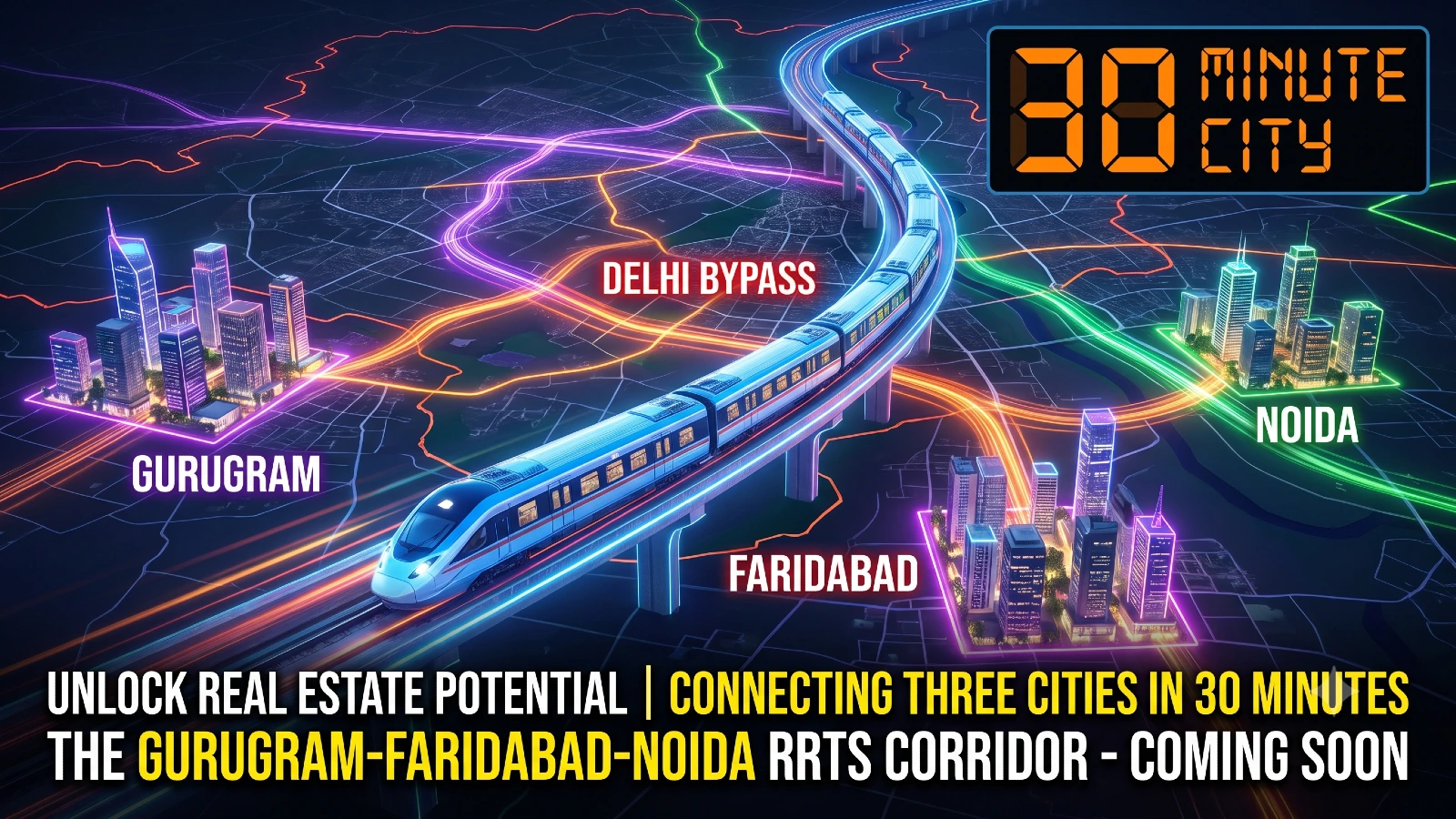
The news that the NCRTC has officially submitted the detailed Project Report (DPR) for a new RRTS corridor connecting Gurugram, Faridabad, and Noida marks a shift in how these satellite cities will eventually function and get connected.
Besides being a transport update; it is also a foundational change in the geography of the NCR. By bypassing Delhi’s core, the proposed high-speed rail aims to turn a two-hour transit ordeal into a predictable 30-minute commute. For real estate, this signals the potential "death of distance," where peripheral pockets previously ignored due to poor connectivity suddenly enter the consideration set for both end-users and investors. This will open whole new pockets of affordable micro-markets which had seemingly disappeared from the current geographical spread of Noida and Gurgaon.
Key Highlights of the RRTS Connectivity Project
DPR Submission: The NCRTC has finalized and submitted the Detailed Project Report for a corridor linking the three major satellite hubs.
Bypassing the Core: The route is designed to provide direct high-speed connectivity between Haryana and Uttar Pradesh without transiting through central Delhi.
Multi-Modal Integration: Plans include seamless synchronization with the Noida Metro, which is further planned to be connected to Aqua Line's 14 km extension, and the Gurugram Metro networks.
Regional Decentralization: The project is a centerpiece of the RRTS Phase 2, intended to reduce the concentration of economic activity within Delhi.
From Speculative Pockets to Functional Hubs
Historically, the real estate markets of Gurugram, Faridabad, and Noida have operated in silos. Gurugram has maintained its status as a fast moving, premium market exemplified by landmark developments such as the DLF Aralias, Magnolias, Camellias and Dahlias, while Noida has focused on service-sector scale and infrastructure-led residential growth. However, with DLF's re-entry into the Noida Expressway corridor, it is sure to further boost the Noida's luxury real estate as well.
The larger question is whether this corridor will finally unlock the stagnant inventories in Greater Faridabad and Northern Gurgaon.
On paper, Faridabad offers a pricing advantage that Gurugram and the Noida Expressway, have long since outpaced. However, without high-speed mobility, that price gap was a reflection of the "inconvenience tax." If the RRTS materializes, that land value is likely to be reassessed. We are looking at a scenario where a professional can work in Cyber City while living in a more affordable (relatively speaking), spacious apartment in Faridabad or Noida's Sector 150, without the daily attrition of NCR traffic.
The Investor Lens: Where Yield Meets Mobility
For investors, the immediate reaction to infrastructure announcements is often speculative. However, the RRTS story requires a more disciplined analysis of where the actual value will accrue.
Faridabad’s Recovery: The city has seen significant supply but uneven absorption. With direct rail links to both Noida’s IT hubs and Gurugram’s corporate districts, Faridabad’s residential plots and "affordable luxury" segments may see a surge in rental demand. Premium residential launches like Hero Homes in Greater Noida also stands to gain with the RRTS connectivity.
Noida Expressway Deepening: While the Noida Expressway already benefits from strong infrastructure, and Grade-A office absorption by Adobe and MediaTek, the RRTS adds a layer of inter-state mobility that makes it viable for a larger pool of tenants who currently choose Gurugram for proximity to work and end up paying a huge premium in rents. Now this very rent can propel their home owning dreams in affordable locations.
Peripheral Appreciation: The stations along the Gurugram-Faridabad stretch, often located in currently underdeveloped areas, represent the "next big trigger." These are early-stage opportunities where capital appreciation is tied directly to the construction milestones of the rail link. The 20k hectare New Noida (DNGIR) master plan also complements RRTS with new avenues for real estate investments, now with ease of approach as well.
On Ground Execution: A Necessary Sub condition
It is easy to get caught up in the vision of a unified NCR, but execution in this region rarely moves as per the plans or projected timelines. The submission of a DPR is a critical first step, but it is not a guarantee of immediate ground-breaking.
Transparency remains a concern in regional development, which remains a rare commodity in the real estate sector. The project now awaits bipartite funding approvals and state guarantees from the Haryana and Uttar Pradesh state governments. As we have seen with previous phases of the RRTS and Metro expansions, timelines can shift based on land acquisition hurdles and inter-state coordination. The market appears optimistic, but investors should treat this as a 7-to-10-year play rather than a short-term flip.
Propulence's Take - The Bottom Line
What often gets overlooked in the excitement over high-speed rail is that real estate usability evolves slowly over time backed by regulatory safeguards like RERA compliance. The RRTS won't just change property prices; it will change the labor market mobility within the NCR.
For the first time, the "satellite cities" are being treated as a cohesive urban cluster rather than appendages of Delhi. If the connectivity holds, the pricing disparity between the different zones of the NCR will likely begin to narrow. The value will move away from the "center" and follow the high-speed corridors into the periphery, provided the social infrastructure, schools, hospitals, and retail, keeps pace with the RRTS tracks.