
Most buyers in Delhi NCR have heard of RERA but very few have actually read it.
The Real Estate (Regulation and Development) Act, 2016 is not primarily a consumer protection law in the way its marketing suggests. It is, more precisely, a financial architecture, a set of constraints placed around capital flows in a sector that spent decades treating buyer advances as discretionary working capital for developers. This difference is very important, because how you read the law determines how you use it. Buyers who approach RERA as a grievance mechanism will use it reactively. Investors who understand it as a structural constraint on developer behaviour can use it predictively, to screen projects before committing capital, not after problems surface.
Propulence, through this RERA Intelligence Series, aims to make every reader genuinely conversant with how the Act works, what its 2026 evolution means in practice, and how to apply it as a real tool for capital allocation decisions in NCR real estate.
What RERA Actually Did to the Market
The structural problem in NCR real estate before 2016 was not primarily developer dishonesty, though that existed too. The deeper problem was a financial model that was architecturally unsound.
A developer would launch a project, collect buyer advances, and use that liquidity to acquire land for the next launch. The second project's early collections would service debt on the first. A third launch funded the second's construction shortfall. The model worked tolerably in an expanding market where every new launch generated fresh inflows. When any single project stalled, a land title dispute, a clearance delay, a market slowdown, the entire structure came under pressure simultaneously. Buyers who had paid into a project two years earlier discovered, often too late, that their money had been redeployed somewhere else entirely.
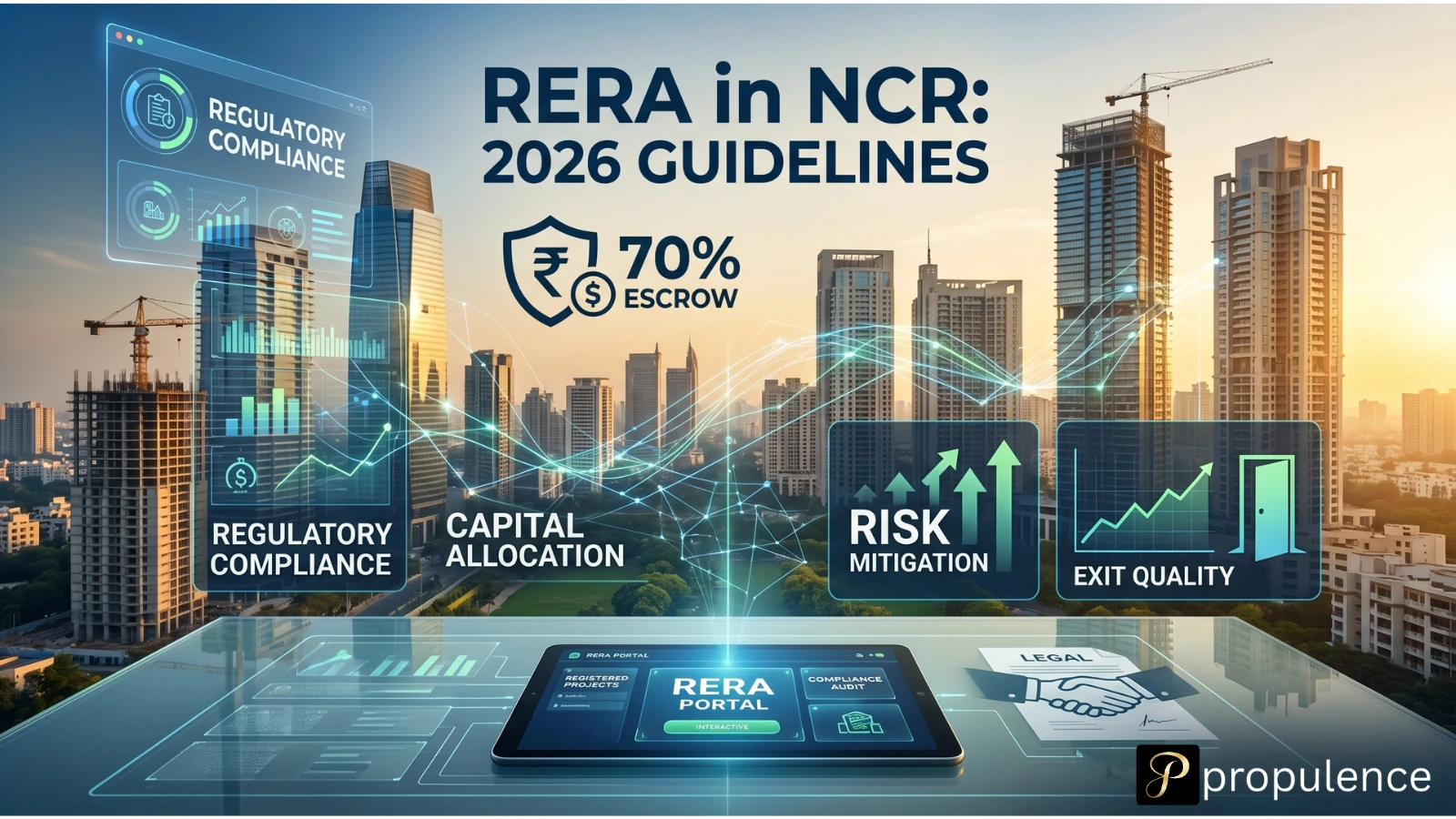
RERA's 70% escrow requirement dismantled this model at its foundation. Seventy percent of all buyer collections must sit in a dedicated project account, accessible only for that project's construction and land costs. The funds cannot be pledged against other borrowings, redirected to a sister company, or moved across projects. Their deployment is auditable through quarterly filings that are publicly accessible on the RERA portal.
If you evaluate any real estate project today, this single rule is more important than any other provision in the Act. A developer collecting aggressively but building slowly is now in a demonstrably exposed position. The escrow becomes a liability on the balance sheet without the operational flexibility developers previously enjoyed, and that pressure is what prevents the old cross-subsidization pattern from reasserting itself.
Two other provisions addressed practices so normalized they were rarely questioned. The mandatory registration threshold removed the informal pre-launch window that developers used to collect advances before a project had legal existence, any project above 500 square metres or eight units must register before it can legally sell or market itself. The carpet area standardization ended the industry's long-running practice of charging buyers for lifts, lobbies, and walls they would never occupy. A luxury buyer in Gurgaon now knows, with legal certainty, what they are paying per usable square foot of living space.
The 2026 Compliance Picture
The original Act concentrated on getting projects registered and keeping money from leaving them. The 2026 compliance picture shifts emphasis to what happens after that baseline: construction quality, contractual fairness, and the enforceability of delivery commitments.
The five-year structural defect liability is the most consequential addition for premium buyers. Developers are now legally responsible for structural defects discovered within 60 months of possession, with an obligation to remedy them at no cost within 30 days of notice. For a segment where construction velocity has sometimes been treated as a competitive advantage, this creates genuine post-handover accountability that previously required civil litigation to pursue.
The move toward standardized sale agreements matters less for what it adds than for what it removes. Force majeure clauses that previously absorbed almost any delay, market conditions, financing difficulties, anything a developer's legal team could slip into the schedule, can no longer be written to contract below the Act's statutory minimums. What the Act guarantees, the agreement must now reflect.
Digital quarterly filings now carry enforcement consequence rather than merely disclosure obligation. The progress reported in a brochure must reconcile with what is reported to the RERA portal. For investors, a developer's quarterly filing discloses construction expenditure against cumulative collections, the single most useful number that most buyers never look at. A widening gap between collections and construction spend is the earliest available signal of capital deployment problems, visible months before a project becomes visibly stalled.
UP-RERA Enforcement: Reading the Recent Signals
Regulatory rules carry real weight only when enforcement is visible and consistent. Two recent UP-RERA actions illustrate where the authority is positioned in 2026.
The penalties levied against MSX Developers and others for marketing units without valid RERA registration are notable less for the fine amount than for how the violations were detected. UP-RERA is actively monitoring social media and digital advertising for unregistered promotional activity. Running a soft launch through Instagram or WhatsApp while the RERA application sits pending is no longer a safe window in this jurisdiction.
For investors, the risk of an unregistered project has nothing to do with the fine the developer faces. Without registration, a developer cannot execute a valid sale agreement. Without a valid sale agreement, you cannot register a conveyance deed. Without a conveyance deed, you have no title and no exit at any price. The entry discount on unregistered projects is real but it also reflects a genuine absence of exit pathway, not a buying opportunity.
The transfer charge cap deserves equal attention. For years, developers in Greater Noida and the Yamuna Expressway corridor charged 2% to 10% of property value when an original allottee attempted to sell before registration. These charges functioned as an investor exit tax. Capping the charge at Rs. 25,000 as a one-time transfer fee changes the arithmetic of secondary market transactions meaningfully. On a Rs. 2 crore apartment, the difference between a 5% and a flat Rs. 25,000 transfer fee is Rs. 9.75 lakh, roughly 40% to 50% of the total return on a typical holding period gain. Compressing that figure improves secondary market liquidity for all participants.
The Decriminalization Proposal
The central government's proposal to replace imprisonment clauses in RERA with higher monetary penalties introduces a variable worth evaluating clearly, without overstating it in either direction.
The case for removing criminal liability from procedural real estate non-compliance is reasonable. Global institutional capital and professionalized corporate developers view personal criminal exposure for regulatory lapses as disproportionate and unpredictable. A fiscal penalty model is how most developed property markets handle this class of violation. The government is not proposing to eliminate accountability; it is proposing to change its form.
The concern is equally grounded. A developer with a healthy balance sheet can absorb a fine and price it into project economics as a cost of doing business. The threat of personal liberty consequences operated on a different register, even when actual imprisonments were rare in practice, the possibility exerted a disciplining effect that a fine schedule does not automatically replicate. Whether the new financial penalties are set high enough to produce equivalent discipline depends entirely on the numbers that eventually get legislated.
The practical consequence for an NCR investor is direct: when statutory threat recedes as a compliance driver, a developer's own standards become the primary determinant of whether they honour their obligations. The burden has not disappeared. It has shifted from the regulator to the buyer. Parsvnath entering CIRP is a direct 2026 illustration of what happens when regulatory compliance fails.
Sentiment, Secondary Markets, and Liquidity Risk
Price appreciation in NCR has remained visible. Exit velocity has not. The gap between those two measures is where liquidity risk accumulates.
When a project develops a sustained pattern of buyer grievances, delivery delays, communication failures, unresolved promises about amenities, the first casualty is not the listed price (though with time it also gets affected). The first and foremost effect is seen in the depth of the secondary market. Sophisticated buyers checking a project's reputation before entering the resale pool will find the complaint register, the legal proceedings, the organized buyer groups. A project carrying that kind of history attracts a smaller pool of willing buyers who negotiate harder and take longer. Supertech Supernova is the most visible live example of a grievance-history project with illiquid secondary market. In these kind of projects the sticker price remains, but the transactions fall down.
This is the illiquidity trap that headline appreciation figures never capture. Capital can sit in an asset that is nominally appreciating while being practically immobile, because selling at the quoted price requires a willing buyer, and the project's history has progressively reduced that pool. Organized buyer collectives coordinating RERA complaints or civil litigation through digital platforms are now a reliable early signal of this condition. An asset in this situation should be treated as distressed regardless of the asking price, because the asking price is typically the last number to reflect the underlying problem.
What RERA Guarantees and What It Does Not
There is a persistent tendency to treat RERA compliance as a proxy for investment quality. The two are related but not the same.
RERA registration ensures that a project exists within a legal structure. The 70% escrow rule reduces the probability that funds can be diverted mid-project. Mandatory quarterly disclosures create an audit trail. Delay interest obligations create financial symmetry between what buyers pay for late instalments and what developers owe for late possession. These are real improvements over the conditions that produced NCR's worst project failures.
What RERA does not determine is whether a project will appreciate, whether the micro-market around it will develop at the pace priced into the entry valuation, whether rental demand will materialize to justify yield assumptions, or whether enough future buyers will find the location desirable when it comes time to sell. The escrow keeps money in the project. It cannot make the project worth owning.
A project can be perfectly compliant and still produce a poor return if the entry price was disconnected from the end-user demand that would have to support it over the long term. Compliance and returns are not the same claim, and only one of them is guaranteed by a registration number.
The Due Diligence Checklist
For anyone evaluating a premium NCR project currently, the RERA portal should be the starting point of due diligence, not the finishing touch.
Registration status must be active and verifiable, not pending, not applied for. An application in process confers no legal protection.
Quarterly filing review is the most underused tool available to buyers. Pull the last three or four filings and compare cumulative collections against reported construction expenditure. Construction spend should track reasonably close to 70% of cumulative collections. A consistent pattern of divergence warrants direct follow-up before committing capital.
Complaint and litigation history is searchable on the UP-RERA and HRERA portals. Look at the developer's history across all registered projects. A developer with a consistently clean compliance record across prior projects is a different risk profile from one whose portfolio shows recurring penalty orders, unexecuted RERA directions, or ongoing organized buyer legal action.
Transfer charge documentation should be obtained in writing before any investment decision, given UP-RERA's Rs. 25,000 cap. Developers have been known to relabel the same charge as a documentation fee, administrative cost, or legal processing charge. The Authority's position is clear: the charge must not exceed Rs. 25,000 per transfer. A developer who resists putting the fee structure in writing is communicating their intentions clearly enough.
Defect liability terms should appear explicitly in the sale agreement, not only in the brochure. The five-year structural defect obligation exists in law. Its practical enforceability in a dispute is stronger when the agreement specifically references and defines its scope.
Before you apply this checklist we recommend checking which all places in Noida are worth investing in 2026.
_________________________________________________________________________________________________________________________________
The Arjun Mehta Verdict
RERA has structurally improved the NCR real estate market. The 70% escrow rule, mandatory registration, the delay interest parity mechanism, and the tightening enforcement posture of both HRERA and UP-RERA have collectively removed the category of risk that produced NCR's worst project failures, the risk of complete fund diversion with no legal recourse.
What remains is a market where risk has shifted rather than disappeared. Structural fraud risk has been compressed; developer quality risk has expanded to fill the space. Fund diversion risk has reduced; valuation risk, buying at a price that future demand cannot sustain, has increased as the market has re-rated on regulatory confidence. Legal title uncertainty has narrowed; liquidity uncertainty, particularly in projects with layered grievance histories, has become more pronounced.
Use the RERA portal to verify that the project will reach possession. Use your own judgement, on entry price, exit demand, rental yield, developer track record, and the honesty of your own assumptions about the market, to verify that possession is worth waiting for. Compliance and returns are not the same claim. Only one of them is guaranteed by a registration number.
For buyers ready to go beyond compliance and evaluate the market itself, start here Noida Real Estate: A Home Buyer and Residential Investor Handbook
_________________________________________________________________________________________________________________________________
Series Navigation: RERA Intelligence, Deep Dives
This article is the anchor piece of Propulence's RERA Intelligence Series. Each article below examines a specific dimension of the regulatory framework in greater depth.
Related reading on Propulence: Jaypee, Adani and Suraksha: How 95% of Homebuyer Money Vanished · Supertech Supernova: Resolution After 14 Years · Parsvnath Developers Enters CIRP · Is Noida a Good Place to Buy Property in 2026? · Noida Real Estate: A Home Buyer and Residential Investor Handbook