
On September 24, the Supreme Court was hearing a case that, on paper, has nothing to do with the National Capital Region. A Bengaluru group called Citizens Action Forum had challenged Karnataka's Premium FAR scheme, the one that lets a builder buy extra floors by paying the state for them, and a bench led by Chief Justice Surya Kant wanted to know one plain thing: was anyone actually widening the roads and sewer lines underneath all that new construction. Nobody in the room had a clear answer. So the CJI reached for a comparison that, going by the bench's own remarks, needed no further explanation. Gurugram, he said, was proof of what happens when a city keeps adding floors without adding infrastructure to match: the system collapses the moment a natural disturbance arrives. Greater Noida, in contrast, was planned with the next 30 to 40 years in mind, , creating a reliable foundation that continues to attract premium real estate developments like Hero Homes to the region.
It was a passing line in a hearing about Bengaluru rooftops, and it will not rewrite a single drainage contract in Haryana. The bench issued notice to the Karnataka authorities and gave them four weeks to respond; it said nothing binding about Gurugram at all. But it is worth noting the fact that the country's top court can now reach for Gurugram's civic record, the way a lawyer reaches for a well-known precedent, without needing to explain the reference any further.
Which makes the next part harder to explain. By Propulence's own tracking of H1 2026, Gurugram is not merely surviving that reputation. It is outselling Noida and Greater Noida on price, even though the two together account for roughly 35% of the region's total transaction volume. If a Supreme Court bench can identify Gurugram's civic collapse in the space of one sentence during a hearing about a completely different city, why does the market that actually prices Gurugram real estate keep behaving as though the problem doesn't exist? Being ostriches with heads in sand doesn't make the problem vanish.
What the Supreme Court Was Really Hearing
Some context, because the CJI's line about Gurugram travelled a lot further online. The petition, by the Citizens Action Forum (CAF) was about Section 18-B of Karnataka's Town and Country Planning Act, under which a developer can buy additional Floor Area Ratio, essentially permission to build taller than the zoning would normally allow, by paying a premium to the state. The Karnataka High Court had upheld the scheme in June. Senior advocate Aditya Sondhi, arguing for the petitioners (CAF), told the bench that road width had effectively become the only test the state applied before handing out that extra FAR, with little real weight given to what it does to Bengaluru's parking, water supply and power load.
Solicitor General Tushar Mehta, defending the scheme, said the additional FAR is capped at 0.6 and that existing parking and setback norms still apply, with the premium money routed into a fund meant for civic upgrades. The bench wasn't convinced that money in a fund is the same as infrastructure on the ground, and that's the point at which Justice Bagchi and the CJI turned to Gurugram and Greater Noida as two versions of what happens after the buildings go up.
The court's actual order was narrow: notice to the Karnataka authorities, four weeks to respond, and a clarification that the extra FAR cannot be used to regularise anything already built illegally. Nothing here touches Haryana's drainage budget or Gurugram's municipal corporation. What it does is put a Supreme Court bench's name behind an observation that Gurugram residents have been making for years without it landing anywhere near this level of attention.
The Record That Made 'Gurugram' a Byword
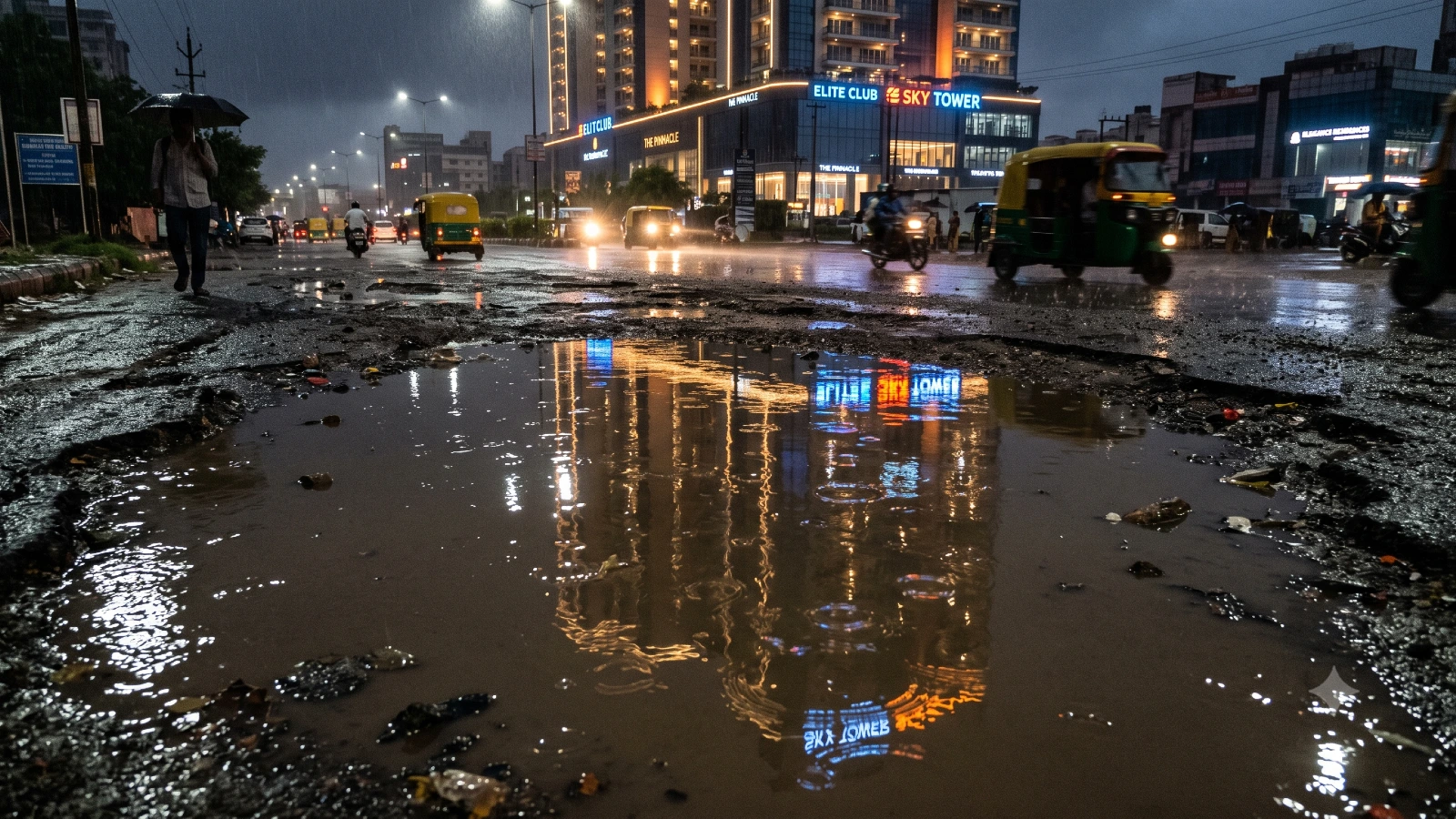
It isn't hard to see what the CJI was pointing at. Barely three weeks before that hearing, on September 2, a single spell of roughly 75mm of rain, on top of a 36-hour downpour that preceded it, was enough to put Sohna Road, Golf Course Road, MG Road, the Delhi-Gurugram Expressway, Rajiv Chowk, Hero Honda Chowk, IFFCO Chowk and Udyog Vihar under water. The Medanta underpass was shut for the fourth time this monsoon. A stretch in Sector 102/102A that had been redone only a year earlier, at a cost of Rs 11.8 crore that was supposed to include a new drainage network, flooded again within hours.
None of this is new, and that's rather the point. Eight people died in flood-related incidents in Gurugram last monsoon. A resident named Mahendar Vazirani has spent more than a year trying to get a court to order a full audit of what the city actually spent its drainage and sewage money on; the case is still pending, with the next hearing due later this month. A state survey cited by the city's own Member of Parliament, Rao Inderjit Singh, found that nearly 75% of Gurugram's natural stormwater drains have disappeared under high-rises and private townships over the years. Land that used to soak up or carry away monsoon runoff was sold, levelled and built on, and in most cases nobody replaced the drainage capacity that land had been quietly providing for free.
And Yet the Market Isn't Blinking
Here is where it gets genuinely strange. Gurugram led the entire NCR in total residential turnover and luxury absorption through H1 2026, on the back of inventory compression in its established sectors and a rush of high-net-worth demand around brand-name launches from DLF. Noida and Greater Noida together held around 35% of the region's total sales volume, which makes that corridor the region's deepest pool of transactional liquidity, but not its price leader.
Independently reported price tracking backs this up over a longer stretch. Gurugram's residential prices moved from roughly Rs 6,150 per square foot in Q1 2020 to about Rs 11,300 per square foot by Q1 2025, a jump of close to 84% in five years, through the same period in which waterlogging, broken roads and traffic complaints barely eased. Rental values in the city's core sectors climbed by 25 to 40% over roughly the same window, which is the number Gurugram bulls quote whenever someone brings up the drains. Noida's climb has been steadier and far less dramatic, an estimated 8 to 12% a year, driven less by scarcity and more by end-users waiting on specific milestones such as the Noida International Airport at Jewar.
So Why Does the City That Floods Keep Winning on Price?
It is not that buyers don't know about the flooding, or that they've decided to look past it out of blind loyalty to the address. It's that most of them are pricing something else entirely, and that something else has, so far, mattered more.
Gurugram still holds the region's densest concentration of the jobs that pay for its real estate. Cyber City, Golf Course Road, Sohna Road, Udyog Vihar and the MG Road belt carry a density of multinational offices, financial services back-offices and corporate headquarters that Noida hasn't matched yet, despite recent gains. For a buyer choosing between a fifteen-minute commute to a well-paying job and a longer one to a better-drained street, the choice usually isn't between good infrastructure and bad infrastructure at all. It's between proximity to that income and everything else, and everything else tends to lose.
There's also a plain supply story sitting underneath the jobs story. Gurugram's established, well-connected sectors have very little vacant land left. Whatever new supply does reach the market there gets priced for its scarcity, not for the condition of the road outside it. When supply is that tight, the price ends up set by whichever buyer cares least about civic quality, and at the top of Gurugram's market, that buyer is often a corporate relocation case or an investor holding the flat as an asset rather than living in it through every monsoon.
And then there's the part that's a little uncomfortable to say plainly: the market has learned to treat flooding as a cost with a fairly predictable ceiling. Negotiated prices in the worst-hit pockets can dip by roughly 3 to 5% right after a bad flood, but listed prices barely move, and both tenants and buyers tend to come back once the rains stop. Flooding shows up for perhaps 20 days out of the three month Monsoons of the year, and public memory of it fades fast. What that adds up to is a market that has priced monsoon disruption as a recurring, bounded cost rather than a reason to stay away.
Greater Noida's Risk Isn't Smaller, Just Different.
The Supreme Court's praise for Greater Noida's long-horizon planning is fair as far as it goes. The city grew under a single planning authority that laid out wider roads and drainage before private townships were allowed to build on top of them, rather than through the patchwork of developer-led growth that shaped Gurugram before it had a unified municipal body at all.
But anyone buying in Noida or Greater Noida on the strength of that comparison alone is skipping over their own version of the problem. This is the corridor where the Jaypee insolvency saga played out, with the Supreme Court itself examining claims that a large share of homebuyer money never made it into actual construction. And it's the corridor where UP's own regulator has had to step in directly, most recently issuing notices to 76 projects over unfiled audits meant to protect the 70% escrow rule that keeps buyer money inside the project it was collected for.
So the honest way to frame it is this: Gurugram's risk shows up every year, on a predictable schedule, in the form of a flooded underpass. Noida's risk shows up less often but hits harder when it does, in the form of a project that quietly stops delivering and takes years of litigation to untangle. A buyer choosing Noida for its 35% share of transactional depth is trading one kind of certainty for another, not trading risk for none. Though it is not that Gurugram doesn't have its fair share of stuck and delayed projects but they are far lesser in the overall quantum of individual defaults.
What's changing on the Noida side is the pace of new infrastructure spending, and it's worth naming, since it's a large part of why the Supreme Court's comparison lands the way it does. L&T has been contracted to build two new metro corridors along the Expressway, the New Noida (DNGIR) master plan is laying out a 20,000-hectare logistics belt tied to Jewar Airport, and the proposed Gurugram-Faridabad-Noida RRTS corridor would, if it actually gets built, connect both job markets on a single fast line. None of this fixes Gurugram's drains. What it does is hand Noida a stronger claim on where NCR's price growth goes next, even while Gurugram keeps the lead for now.
What This Actually Means If You're Buying Right Now
Nobody reading this needs to be told to pick the city with no problems, because that city doesn't exist in the NCR. The question that remains is which failure you can live with.
If price growth and rental yield matter more to you than civic comfort, Gurugram's established, land-starved sectors are still worth a close look, provided you actually do the homework the brochure won't do for you: check the specific micro-location's flood history before signing anything, stay away from basements and basement parking in low-lying pockets, and budget for higher running maintenance than the sales pitch implies.
If a predictable exit and lower climate exposure matter more to you than squeezing out the last bit of appreciation, Noida Expressway and Greater Noida West carry that trade instead, as long as you verify RERA compliance project by project rather than trusting the region's overall reputation. Our street-level walkthrough of Noida Expressway's residential sectors is a reasonable place to start that due diligence.
The one thing that could genuinely reshuffle this over the next decade is the RRTS link, by putting both job markets within reach of either city's housing stock. Until that's actually running, the read on H1 2026 is fairly simple: Gurugram is being paid for its jobs and its scarcity, not for its drains, and Greater Noida is being paid for its planning, with the Supreme Court's blessing now on the record, even though its ceiling on price still sits below Gurugram's.
So is Noida a safer real estate investment than Gurugram?
That depends on which risk worries you more. Noida and Greater Noida have fewer chronic drainage failures thanks to planned, authority-led development, but the corridor has also seen serious developer insolvency cases across larger projects. An informed decision leads to right investment. Hence due diligence, market information and deep dive into the builder financials and RERA QPR becomes important before you decide to put in your hard earned money.